Book a consult
Services

Production SI, engineered end to end, six eval-gated service lines.

Visit Services →
Solutions

The same playbook, tuned to the constraints of the sectors we ship into most.

Visit Solutions →
Live Projects

Proof, not promises, selected case studies and recognition.

Visit Live Projects →
How we work

A transparent, 3-phase playbook from first audit to embedded team.

Visit How we work →
Studio

The senior team behind the work, and how to reach us.

Visit Studio →
octalcode
Services
Solutions
Live Projects
How we work
Studio
● OCTALCODE · INFINITE SOLUTIONS · ONE AGENCYBook a consult ↗

LLM Applications

SI features that earn their place in your P&L.

Most SI features stall in the gap between a promising demo and a system the business can rely on. We build LLM applications, autonomous agents, and RAG pipelines that clear that gap, with the eval framework and MLOps infrastructure to keep them dependable in production.

01 · What we build

Six capabilities, one team.

We start with the business outcome you are after, then assemble the capabilities that get you there. The same senior engineers stay with you across model selection, RAG architecture, agent design, and eval infrastructure.

01 · Capability

Chat & Copilot Apps

Customer-facing assistants, internal copilots, and domain-specific chatbots with RAG, tool-calling, and eval frameworks baked in from day one.

02 · Capability

Autonomous Agents

Multi-step agents that plan, use tools, and complete goals without hand-holding. We architect the loop, the guardrails, and the observability.

03 · Capability

RAG Pipelines

Retrieval-augmented generation over your private knowledge: vector stores, chunking strategies, hybrid search, and continuous reranking.

04 · Capability

Fine-Tuning & Adapters

Domain adaptation via LoRA, QLoRA, and instruction fine-tuning. We build the training pipeline, run evals, and version every checkpoint.

05 · Capability

LLM API Integrations

OpenAI, Anthropic Claude, Google Gemini, and self-hosted Llama; we handle prompt engineering, token budgeting, and multi-model routing.

06 · Capability

Evaluation Frameworks

Custom eval suites measuring accuracy, factuality, latency, and safety. CI-integrated so regressions block deploys, not users.

Straight answers

The short version.

What does an LLM application development company do?

An LLM application development company designs, builds and runs software that uses large language models to do real work: customer-facing assistants, internal copilots, autonomous agents and retrieval systems over private knowledge. The work starts before any model is chosen. A good team audits your data, use case and latency limits, then defines an eval suite covering accuracy, factuality, latency and safety, so every later decision is measured against it. From there it handles model selection across hosted providers such as OpenAI, Anthropic and Google or self-hosted open models, prompt engineering, token budgeting, multi-model routing, tool-calling, and fine-tuning with adapters when a narrow task needs it. It also builds the parts a demo skips: guardrails, logging, drift monitoring and CI gates that stop a regression before users see it. When you compare vendors, ask to see their eval harness, how they keep personal data out of prompt logs, and what they hand over at launch: tests, a runbook and monitoring.
How do you take an SI feature from demo to production?

You take an SI feature from demo to production by replacing the impressions that made the demo convincing with measurements, controls and operations. Start by writing down what working means: collect real inputs from users, record the outputs a domain expert would accept, and turn them into an eval set scored for accuracy, hallucination, safety and latency. Next, run that set in CI so any prompt, model or retrieval change that lowers the score blocks the deploy. Then add guardrails: input validation, scope limits, refusal when the system lacks grounds to answer, and a human escalation path for high-stakes cases. Wire in observability for every model call, covering token cost, latency, prompt and response logs with personal data removed, and an audit trail. Finally, plan for change: providers update models, data shifts, and drift monitoring has to compare live behaviour with the launch baseline. Octalcode works this way, in short build sprints with working software shown at each checkpoint.

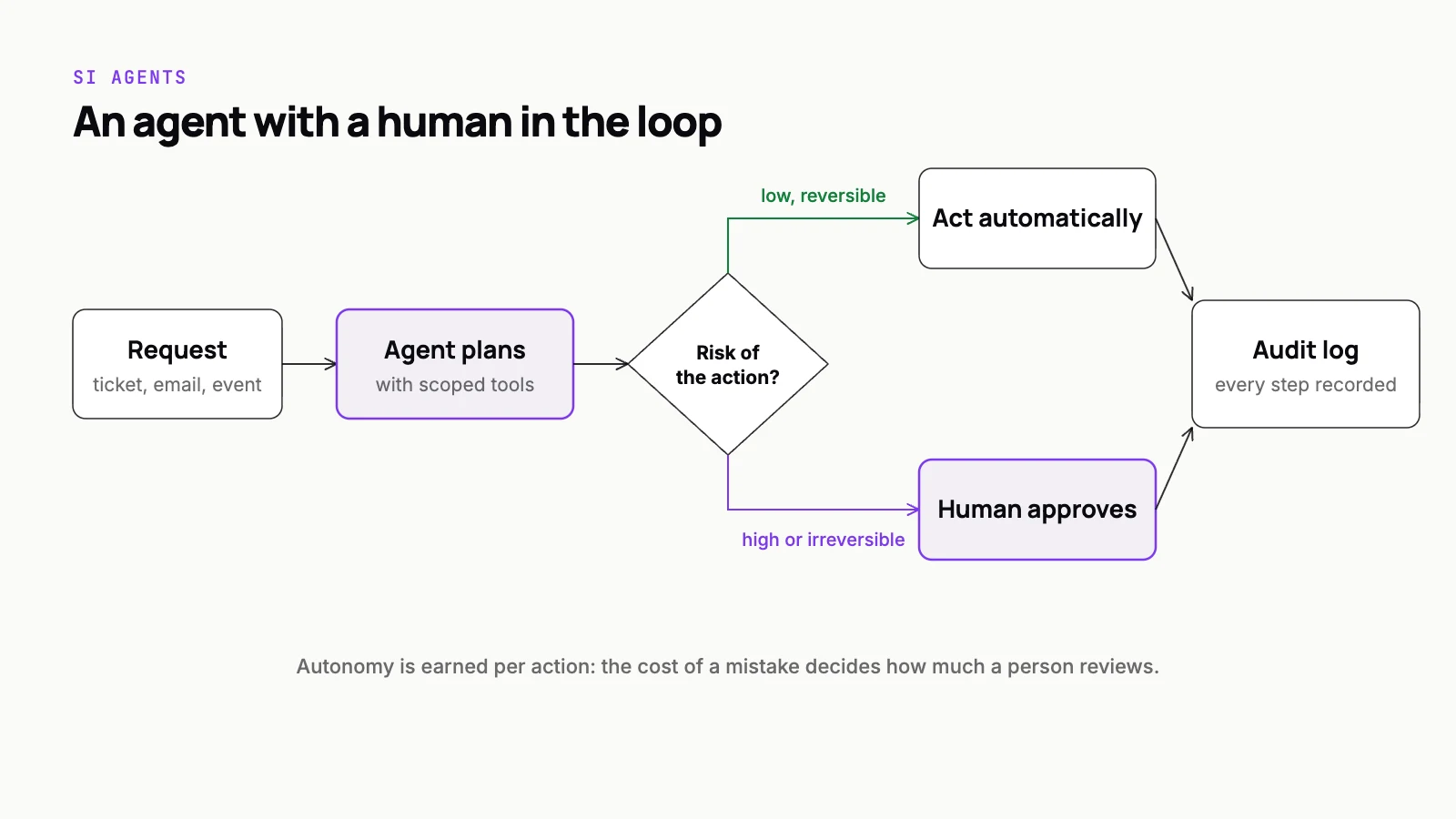
Diagram of an SI agent with a human in the loop: a request reaches an agent that plans with scoped tools; low-risk, reversible actions run automatically, high-risk or irreversible actions wait for human approval, and every step is written to an audit log.
Autonomy is earned per action: the cost of a mistake decides how much a person reviews.

02 · How we ship

Evals before demos.

  1. Scoping & data audit

    We assess your data, use-case, and latency constraints before selecting a model. No model recommendation without seeing your data first.

  2. Eval harness first

    Before writing application code, we define the eval suite: accuracy, latency, safety, hallucination rate. Every subsequent decision is measured against it.

  3. Iterative builds

    Short build sprints with demos at each checkpoint. You see working software, not slide decks.

  4. Production handover

    We hand over with CI-integrated evals, drift monitoring, a runbook, and post-launch support.

03 · Tech stack

Model-agnostic by design.

Models

  • GPT-5.5
  • Claude Fable 5
  • Gemini 3.1 Pro
  • Llama 4
  • Mistral Large 3

Frameworks

  • LangChain
  • LlamaIndex
  • DSPy
  • AutoGen
  • CrewAI

Vector DBs

  • Pinecone
  • Weaviate
  • Qdrant
  • pgvector
  • ChromaDB

Evals

  • RAGAS
  • Deepeval
  • Braintrust
  • Custom harnesses

Proof, not promises

Twenty-plus SI systems shipped to production. One playbook, six industries, and a team that stays past launch.

SI systems live in production
20+
Senior engineers & researchers
21+
Upwork rating, 3 verified reviews
5.0
Founded in Lahore
2022
Verified Upwork clientSI product engagement · 5-star review

04 · Common questions

Before you brief us.

How long does it take to build a production LLM app?
It depends on data readiness, integration complexity, and required eval coverage. We share a week-by-week roadmap at the end of discovery.
Which model should we use: OpenAI, Claude, or open-source?
We run model selection on your actual data and use-case before recommending. Cost, latency, context window, and compliance requirements all factor in. We often start with a hosted frontier model and move to a fine-tuned open-source model once the eval bar is set.
Do you work with our existing codebase or start fresh?
Both. We regularly integrate LLM features into existing platforms (Python, Node.js, Rails, or .NET). We also build greenfield SI-native apps when the brief calls for it.
What does SOC 2-aligned development mean in practice?
It means no PII in prompt logs, encrypted-at-rest storage for embeddings, audit-logged inference calls, and a documented data-handling policy you can hand to your compliance team.

Available for new engagements

Ready to put SI to work in production?

30 minutes, one of our seniors, no slide deck. By the end of the call you will know whether we are the right team, and if not, who is.

Or call +1 (512) 710-5701

Let's scope it.Instant answers · free project scoping