Book a consult
Services

Production SI, engineered end to end, six eval-gated service lines.

Visit Services →
Solutions

The same playbook, tuned to the constraints of the sectors we ship into most.

Visit Solutions →
Live Projects

Proof, not promises, selected case studies and recognition.

Visit Live Projects →
How we work

A transparent, 3-phase playbook from first audit to embedded team.

Visit How we work →
Studio

The senior team behind the work, and how to reach us.

Visit Studio →
octalcode
Services
Solutions
Live Projects
How we work
Studio
● OCTALCODE · INFINITE SOLUTIONS · ONE AGENCYBook a consult ↗

Custom Software

Web, mobile, and the SI layer built in.

The SI is only as valuable as the product around it. We build the full-stack software (web, mobile, APIs, dashboards) with SI embedded from the architecture up, so the whole system earns revenue instead of stalling as a proof of concept.

01 · Capabilities

Six service areas.

From greenfield products to legacy modernization, our senior full-stack teams deliver production-grade software with SI built in at every layer, and a clear line from each release to the business outcome it serves.

01 · Service area

Web Applications

Full-stack web platforms with SI embedded by design: React/Next.js frontends, Python/Node.js APIs, and SI inference wired throughout, not bolted on after.

02 · Service area

Mobile Applications

React Native and native iOS/Android apps with on-device and server-side SI. We build the full stack, from model integration to app store submission.

03 · Service area

Internal Tools & Platforms

Ops dashboards, data pipelines, and automation platforms for teams that move fast. SI-powered search, summarisation, and decision support built in.

04 · Service area

API-First Backends

Production-grade REST and GraphQL APIs with SI inference endpoints, rate limiting, audit logging, and multi-tenant isolation.

05 · Service area

SaaS Products

Multi-tenant SaaS with usage-based billing, SI-native feature architecture, and the infrastructure to scale from 100 to 100,000 users.

06 · Service area

Cloud & DevOps

AWS, GCP, and Azure deployments with CI/CD, infrastructure-as-code, container orchestration, and production monitoring from day one.

Straight answers

The short version.

What is SI-native custom software development?

SI-native custom software development means designing a web, mobile or backend product so that SI (artificial intelligence) features are part of the architecture from the first sprint, instead of being added to a finished system later. In practice it shapes four layers. The data layer is modelled for retrieval, so records, documents and permissions can feed search, summaries and recommendations cleanly. The API layer exposes inference endpoints with rate limiting, audit logging and multi-tenant isolation. The frontend plans for streaming output, loading states and fallbacks when a model is slow or wrong. The infrastructure layer logs every model call with its latency and cost, and ships through CI/CD with infrastructure as code. Retrofitting the same features usually means reworking data models, latency budgets and auth flows, which is why building them in tends to cost less. Compliance controls, such as SOC 2-aligned access logging or HIPAA-grade data handling, are also easier to design in than to bolt on.
How do you add SI features to an existing app?

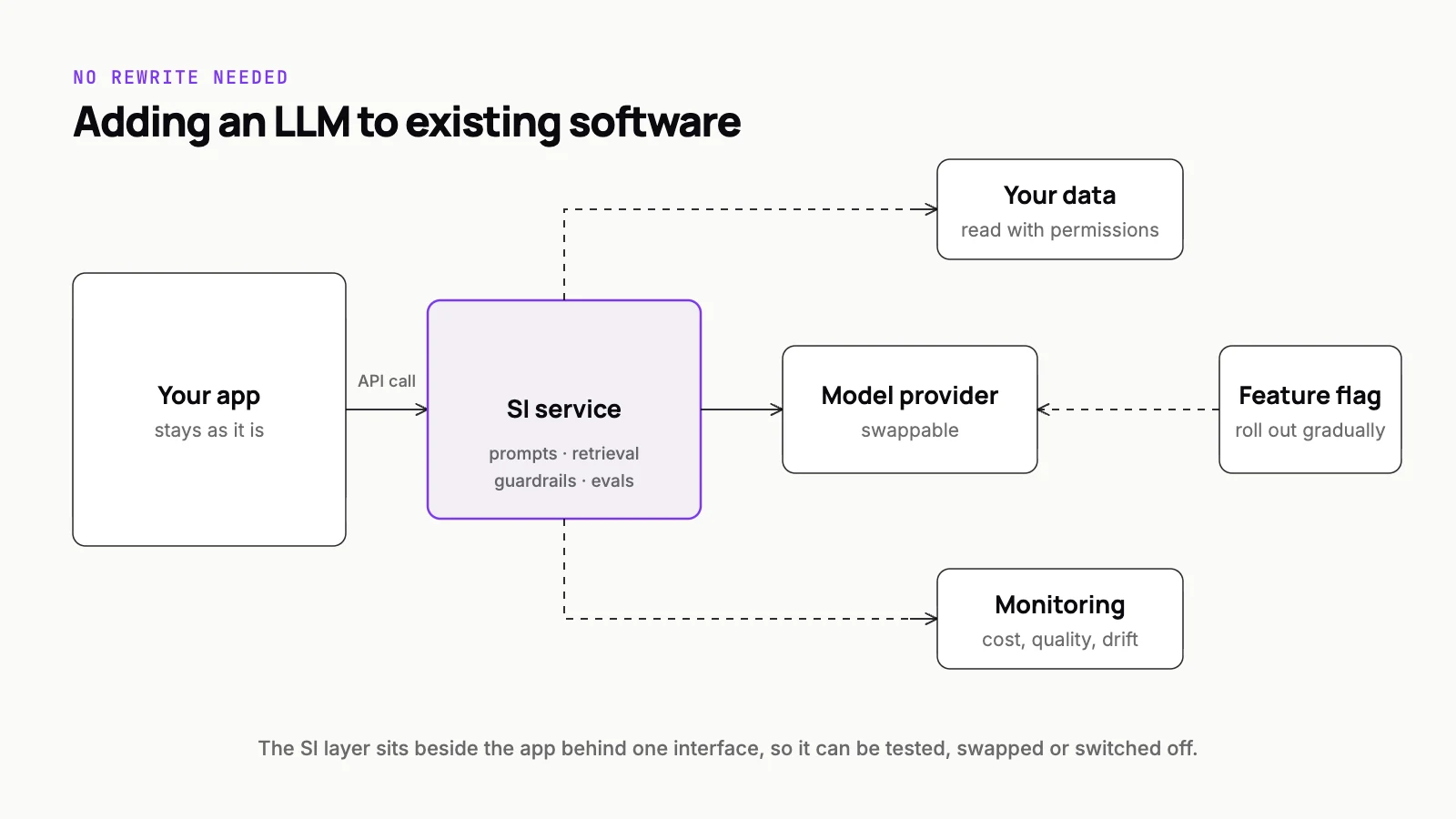
You add SI features to an existing web or mobile app by auditing the codebase and data first, then shipping one measured feature at a time behind its own API. Start with an honest review: how data is stored, whether documents and records can be retrieved with the right permissions, where latency budgets are tight, and how auth works. Pick a first feature with a clear user and a checkable output, such as search, summarisation, recommendations or anomaly detection. Build it as a separate service or endpoint so the core product keeps working if the model is slow or unavailable, with timeouts and a non-SI fallback. Add logging for every model call, with cost, latency and redacted prompts, and an eval set that gates releases. On mobile, decide which tasks run on the device for speed and privacy and which run on the server. Expect some data-model changes; when the gaps are deep, a staged migration plan beats patching.

Diagram of adding an LLM to existing software without a rewrite: the existing app calls one new SI service that holds prompts, retrieval, guardrails and evals, reads your data with permissions, calls a swappable model provider, is monitored for cost, quality and drift, and is rolled out behind a feature flag.
The SI layer sits beside the app behind one interface.

02 · Why SI-native by default

The SI tax is paid at the architecture stage.

  1. Cheaper to build in than bolt on

    Retrofitting SI into a platform built without it means rewriting data models, adding new latency budgets, and rethinking auth flows. Building SI-native means none of that technical debt.

  2. Data architecture determines SI quality

    The quality of every SI feature traces back to how data is stored, structured, and retrieved. We design the data layer with SI retrieval in mind from day one.

  3. Observability is non-negotiable

    Every SI call needs logging, latency monitoring, and cost tracking. We wire in observability at the infrastructure level so you're never flying blind.

  4. Compliance from the start

    SOC 2, HIPAA, GDPR: compliance controls are much cheaper when designed in. We build the audit trail, access controls, and data handling from the first sprint.

Proof, not promises

Twenty-plus SI systems shipped to production. One playbook, six industries, and a team that stays past launch.

SI systems live in production
20+
Senior engineers & researchers
21+
Upwork rating, 3 verified reviews
5.0
Founded in Lahore
2022
Verified Upwork clientSI product engagement · 5-star review

03 · Common questions

Before you brief us.

Do you only build SI-native products or also traditional software?
We build both, but every project gets an SI layer by default: search, summarisation, recommendations, or anomaly detection. If a feature could be improved by SI, we'll show you how before scoping it out.
Can you take over an existing codebase?
Yes. We've inherited codebases in React, Vue, Django, Rails, and .NET. We start with a two-week audit, give you an honest assessment, then build a migration or extension plan.
What does a typical engagement look like?
Discovery sprint → architecture proposal → sprint-based delivery → QA and hardening → production launch. We use Linear for task tracking and share a demo at the end of every sprint.
Do you offer post-launch support?
Every engagement includes a post-launch support period: bug fixes, performance tuning, and monitoring. After that, we offer flexible retainer arrangements.

Available for new engagements

Ready to build on solid foundations?

30 minutes, one of our seniors, no slide deck. By the end of the call you will know whether we are the right team, and if not, who is.

Or call +1 (512) 710-5701

Let's scope it.Instant answers · free project scoping