Book a consult
Services

Production SI, engineered end to end, six eval-gated service lines.

Visit Services →
Solutions

The same playbook, tuned to the constraints of the sectors we ship into most.

Visit Solutions →
Live Projects

Proof, not promises, selected case studies and recognition.

Visit Live Projects →
How we work

A transparent, 3-phase playbook from first audit to embedded team.

Visit How we work →
Studio

The senior team behind the work, and how to reach us.

Visit Studio →
octalcode
Services
Solutions
Live Projects
How we work
Studio
● OCTALCODE · INFINITE SOLUTIONS · ONE AGENCYBook a consult ↗

Telecommunications

SI for networks that never sleep.

Telecom runs on margins, scale, and uptime. We build churn prediction, network anomaly detection, and SI-driven customer care that operate at carrier data volumes in real time, cutting cost-to-serve and protecting the SLAs your customers are paying for.

01 · Use cases

Six ways we deploy SI in telecom.

From churn prediction to network anomaly detection, every engagement is built for the data volumes, latency requirements, and regulatory constraints of telecom.

01 · Use case

Churn Prediction & Retention

ML models that identify at-risk subscribers before they cancel. Triggered retention campaigns with predicted LTV scoring.

02 · Use case

Network Anomaly Detection

Real-time anomaly detection across network telemetry. Identify degradation, outages, and security incidents before customers complain.

03 · Use case

SI Customer Care

LLM agents trained on your support playbooks, billing systems, and network status APIs. Resolve common issues without human escalation.

04 · Use case

Predictive Maintenance

Failure prediction models for network infrastructure. Identify equipment likely to fail before it causes downtime.

05 · Use case

ARPU Optimisation

Propensity models for upsell, cross-sell, and plan migration. Personalised offers served at the right moment in the customer journey.

06 · Use case

Document & Contract Intelligence

RAG over roaming agreements, regulatory submissions, and SLAs. Answer questions over your internal document corpus instantly.

Straight answers

The short version.

How do SI agents handle telecom customer care and network tickets?

SI agents handle telecom care by reading the same playbooks, billing records and network status feeds a human agent would use, resolving routine cases and escalating the rest with full context. A typical flow identifies the subscriber, checks for a known outage in the area, looks up the account and applies the matching playbook step, such as explaining a charge or resetting a service. Confidence thresholds decide when to hand off, and the handoff carries the conversation, the checks already run and a suggested next action. Every tool call is logged so supervisors can audit what the agent did. The same pattern works inside network operations: Octalcode built Helio Copilot, a network-ops agent that triages SIP events in real time, correlates incidents and resolves routine tickets, escalating only what needs a person, with full audit trails. Agents stay within read and write permissions agreed with the operator's security team.
How does real-time network anomaly detection work for telecom operators?

Real-time network anomaly detection streams telemetry into models that learn normal behaviour for each cell, link or network element and raise an alert when a signal moves outside that pattern. Events arrive through a streaming layer, features such as error rates, latency and traffic mix are computed in-stream, and scoring happens inside the same pipeline rather than in an overnight batch. Baselines account for time of day, weekday and seasonal load, so a busy evening does not look like a fault. Alerts group related signals into one incident with its likely source, so operations teams triage a single event instead of a flood of alarms. Predictive maintenance extends the same approach to equipment, flagging hardware likely to fail before it causes downtime. Thresholds are tuned with the operations team against past incidents, every alert records the data that triggered it, and drift monitoring shows when a baseline has gone stale and needs retraining.

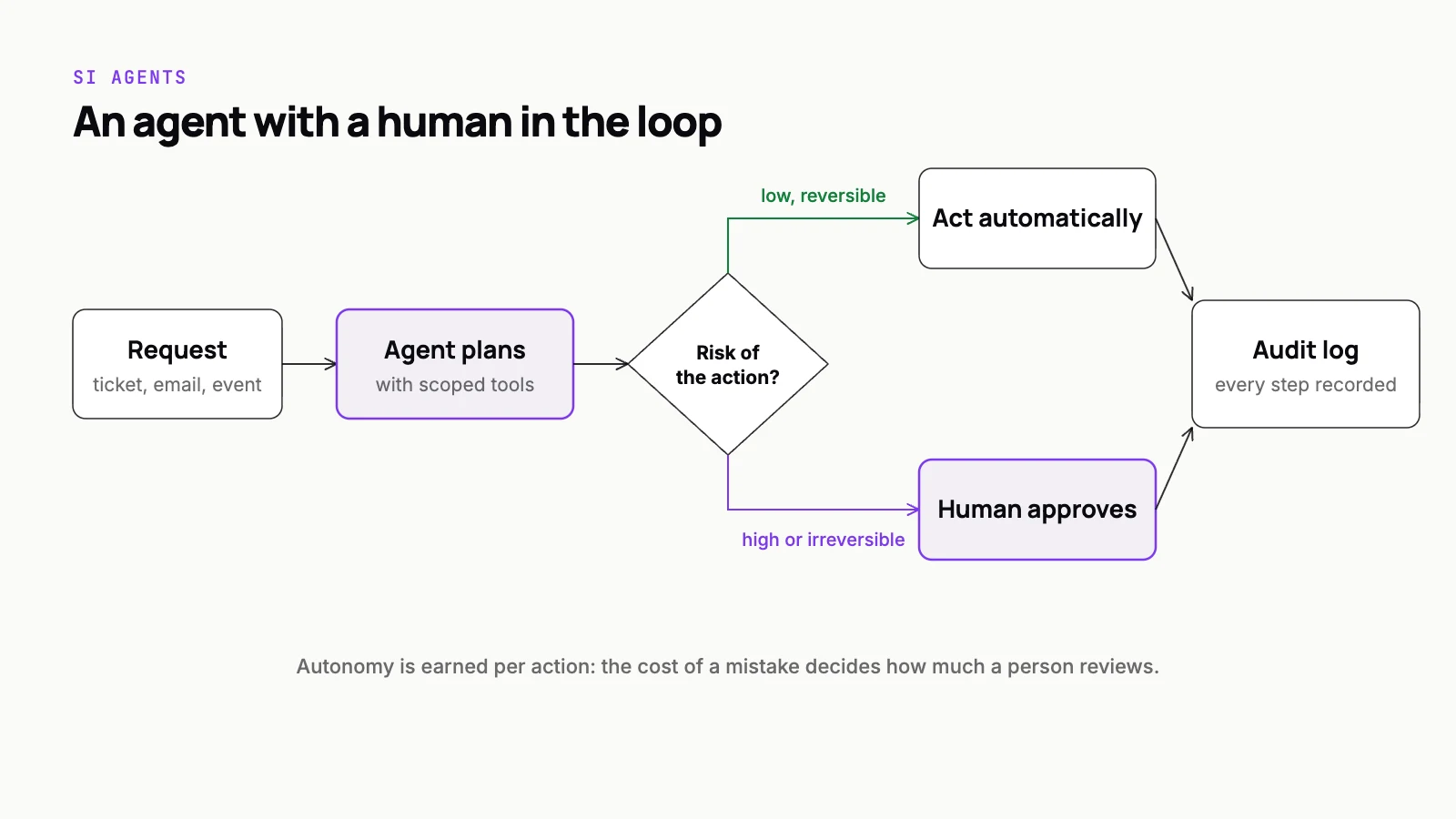
Diagram of an SI agent with a human in the loop: a request reaches an agent that plans with scoped tools; low-risk, reversible actions run automatically, high-risk or irreversible actions wait for human approval, and every step is written to an audit log.
Autonomy is earned per action: the cost of a mistake decides how much a person reviews.

02 · What makes telecom SI hard

Four challenges we solve first.

  1. Data volume at telecom scale

    Billions of network events per day. SI pipelines need streaming ingestion and efficient feature stores, not batch jobs running overnight.

  2. Real-time latency requirements

    Fraud detection, anomaly alerts, and churn signals need sub-second inference. We build for streaming, not dashboards.

  3. Legacy system integration

    Telecom runs on OSS/BSS systems that are decades old. We integrate SI layers without requiring infrastructure replacement.

  4. Regulatory data residency

    Telecom data is subject to strict jurisdiction requirements. We design data architectures that enforce residency from the start.

Proof, not promises

Twenty-plus SI systems shipped to production. One playbook, six industries, and a team that stays past launch.

SI systems live in production
20+
Senior engineers & researchers
21+
Upwork rating, 3 verified reviews
5.0
Founded in Lahore
2022
Verified Upwork clientSI product engagement · 5-star review

03 · Common questions

Before you brief us.

Can you process network telemetry at scale?
Yes. We build streaming pipelines on Kafka, Flink, and Spark Streaming designed for the event volumes telecom infrastructure generates. Feature engineering happens in-stream, not in batch.
How do you integrate with existing OSS/BSS systems?
We build SI feature layers that sit alongside your existing systems via APIs and event streams. We don't require a core systems migration; we work with what you have.
What's a realistic churn reduction from an ML model?
It depends on your data and your retention tooling. Well-scoped churn models focus effort on the subscribers most at risk, and we measure the lift against a holdout group so you see the real effect rather than a projection.
How do you handle multi-jurisdiction data residency requirements?
We design data architectures with residency as a first-class constraint: regional data stores, jurisdiction-aware routing, and audit logs that satisfy regulatory review. This is specified in the architecture phase, not retrofitted.

Available for new engagements

Book a free telecom SI scoping call.

30 minutes, one of our seniors, no slide deck. By the end of the call you will know whether we are the right team, and if not, who is.

Or call +1 (512) 710-5701

Let's scope it.Instant answers · free project scoping