Book a consult
Services

Production SI, engineered end to end, six eval-gated service lines.

Visit Services →
Solutions

The same playbook, tuned to the constraints of the sectors we ship into most.

Visit Solutions →
Live Projects

Proof, not promises, selected case studies and recognition.

Visit Live Projects →
How we work

A transparent, 3-phase playbook from first audit to embedded team.

Visit How we work →
Studio

The senior team behind the work, and how to reach us.

Visit Studio →
octalcode
Services
Solutions
Live Projects
How we work
Studio
● OCTALCODE · INFINITE SOLUTIONS · ONE AGENCYBook a consult ↗

SI agent development

Agents that do the work, within limits.

We build SI agents that carry out multi-step work in your systems. They plan, call the tools you approve, check their own results and hand off to a person when the stakes or the uncertainty are too high. Every action is scoped, logged and tested before it runs in production.

01 · What we build

Workflow agents

Agents that carry one business process from start to finish: triaging a support queue, reconciling records, preparing a case file, updating the CRM. Each starts with clear inputs, a short list of allowed actions and a written definition of done.

02 · What we build

Tools and system access

Agents act through tools: your APIs, databases, ticketing, email and internal services. Every tool gets a typed interface, its own permissions and rate limits, and read-only access unless writing is the job. We use the Model Context Protocol where it fits your stack.

03 · What we build

Human approval

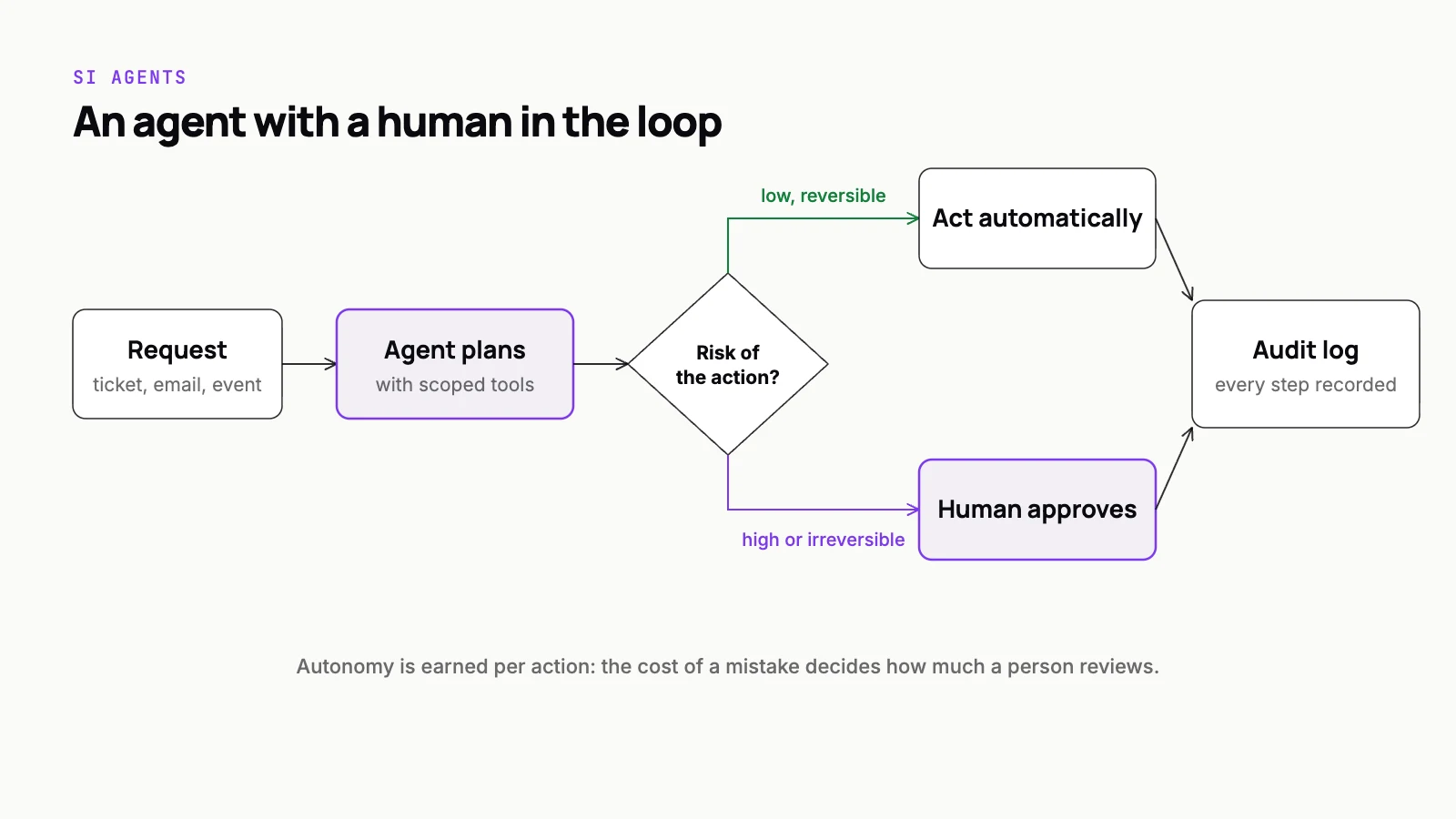
Low-risk, reversible actions run on their own. High-risk or irreversible ones wait for a person, who sees what the agent plans to do and why, and can approve it, edit it or send it back.

04 · What we build

Multi-agent systems

When one agent’s job grows too wide, we split it: a planner that breaks the work down, specialists with narrow tools, and a checker that reviews the result. We split only when it measurably beats a single agent, because every hand-off adds cost and another place to fail.

05 · What we build

Evaluation and tracing

Agents are tested on recorded scenarios before release: did the task get done, were the right tools called with the right inputs, did it stay inside policy, and did it hand off when it should have. In production every step is traced, so a failure can be replayed and fixed.

Straight answers

The short version.

What does an SI agent development company do?

An SI agent development company designs, builds and runs software agents that carry out multi-step work inside a business’s own systems. Unlike a chatbot, which answers questions, an agent plans the steps of a task, calls tools such as APIs, databases, ticketing and email, checks the results and decides what to do next. The work starts with scoping: one workflow, its inputs, the actions the agent may take and a written definition of done. The team then builds typed, permissioned tool interfaces, decides which actions run automatically and which wait for human approval, and writes test scenarios that score task completion, tool use, policy compliance and escalation. In production it traces every step so failures can be replayed, and it monitors cost and behaviour as models change. When you compare vendors, ask how they limit what an agent can do, how they test it before release, and what you own at the end.
How do you keep an SI agent safe in production?

You keep an SI agent safe in production by limiting what a mistake can cost, then proving its behaviour with tests and logs before widening its freedom. Give each tool the narrowest access that does the job: read before write, drafts before sends, and credentials held by the tool layer, never placed in prompts. Classify actions by risk, so reversible, low-impact steps run automatically while irreversible or high-impact ones wait for a person who can see the planned action and the reason for it. Treat retrieved documents and tool outputs as untrusted input, because they can carry instructions meant to redirect the agent. Before every release, run the agent through recorded scenarios that check task completion, tool choice and arguments, policy limits and escalation. In production, trace every plan, tool call and approval, alert on unusual patterns, and keep a switch that pauses the agent without taking the product down.

Diagram of an SI agent with a human in the loop: a request reaches an agent that plans with scoped tools; low-risk, reversible actions run automatically, high-risk or irreversible actions wait for human approval, and every step is written to an audit log.
Autonomy is earned per action: the cost of a mistake decides how much a person reviews.

02 · How we build them

Narrow, then wider.

  1. One workflow first

    We start with one workflow, its allowed actions and its test cases. An agent that does one job reliably is worth more than one that does ten unpredictably.

  2. Least privilege

    Tools get the narrowest access that does the job: read before write, drafts before sends, and no credentials inside prompts.

  3. Autonomy is earned

    Actions start supervised and move to automatic only when the evals and the logs show they are safe to.

  4. Every step on the record

    Plans, tool calls, results and approvals are logged, so you can audit what the agent did and why.

03 · Is an agent the right tool?

Often it is not.

Choose an agent when

  • The work takes several steps across systems
  • Inputs vary and need judgement
  • A person can review the risky steps

Choose plain automation when

  • The steps are fixed and predictable
  • Rules cover every case
  • An existing tool already connects the systems
Zapier or n8n vs a custom agent

Choose neither when

  • The process itself is not settled
  • Mistakes are costly and nobody reviews them
  • Nobody owns the outcome
Agent, chatbot or automation?

04 · Tech stack

Chosen per workflow.

Models

  • OpenAI
  • Anthropic Claude
  • Google Gemini
  • Open models (Llama, Mistral)

Orchestration

  • LangGraph
  • OpenAI Agents SDK
  • Claude Agent SDK
  • Custom orchestration

Tools

  • Model Context Protocol
  • Function calling
  • Typed tool schemas

Operations

  • Tracing (Langfuse, LangSmith)
  • Eval harnesses
  • Approval queues

05 · Common questions

Before you brief us.

What is the difference between an SI agent and a chatbot?
A chatbot answers questions. An agent takes actions: it plans the steps of a task, calls tools in your systems, checks the results and decides what to do next. That is why agents need permissions, approvals and audit logs that a chatbot does not.
Can an agent work with our existing systems?
Yes. Agents act through the APIs, databases and services you already run. Where a system has no API, we would usually rather add a small, permissioned API than have an agent click through a screen.
How do you stop an agent from doing the wrong thing?
No system can promise it will never be wrong, so we limit what a mistake can cost. Tools are scoped to the job, risky actions wait for a person, the agent is tested on recorded scenarios before every release, and every step is logged and monitored in production.
Who owns the agent and its code?
You do. Clients own their IP and code, including prompts, tool definitions, test scenarios and the evaluation harness.
Where does the agent run?
In your cloud, with hosted models from OpenAI, Anthropic or Google, or with open models you run yourself. The choice is made per task, on your own test scenarios.
How do we start?
Pick one workflow and write down its inputs, allowed actions and what done looks like. Our guide to scoping an agent project walks through it, and a senior team can be embedded inside 14 days once the scope is agreed.

Available for new engagements

Hand off the work, keep the control.

30 minutes, one of our seniors, no slide deck. By the end of the call you will know whether we are the right team, and if not, who is.

Or call +1 (512) 710-5701

Let's scope it.Instant answers · free project scoping