Book a consult
Services

Production SI, engineered end to end, six eval-gated service lines.

Visit Services →
Solutions

The same playbook, tuned to the constraints of the sectors we ship into most.

Visit Solutions →
Live Projects

Proof, not promises, selected case studies and recognition.

Visit Live Projects →
How we work

A transparent, 3-phase playbook from first audit to embedded team.

Visit How we work →
Studio

The senior team behind the work, and how to reach us.

Visit Studio →
octalcode
Services
Solutions
Live Projects
How we work
Studio
● OCTALCODE · INFINITE SOLUTIONS · ONE AGENCYBook a consult ↗

SI SaaS Products

Ship SI features that users actually keep.

For a SaaS business, an SI feature has to lift activation, retention, and expansion, not just ship. We build copilots, embedded LLMs, and autonomous workflows into your product, with the evals and observability to prove they move the metrics your investors track.

01 · Use cases

Six SI features that retain users.

From in-product copilots to eval infrastructure, every engagement is built around shipping SI that earns its place in your product and justifies premium pricing.

01 · Use case

In-Product SI Copilots

Context-aware SI assistants embedded in your SaaS UI. Answer questions, automate tasks, and surface insights from within your product.

02 · Use case

Automated Workflow Agents

Autonomous agents that complete multi-step tasks on behalf of users: research, drafting, data entry, and cross-tool orchestration.

03 · Use case

SI-Powered Onboarding

LLM-guided setup flows that reduce time-to-value. Users describe what they want; the SI configures it.

04 · Use case

Data Q&A Features

Natural language query over your users' data. "Show me last month's revenue broken down by product": answered without a BI tool.

05 · Use case

SI-Generated Content

Personalised content generation inside your product: reports, summaries, recommendations, and drafts tailored to each user's context.

06 · Use case

Eval & Observability Infrastructure

The monitoring layer that tells you whether your SI features are working. Eval pipelines, quality scores, and regression alerts.

Straight answers

The short version.

Why do SI features in SaaS products fail after launch?

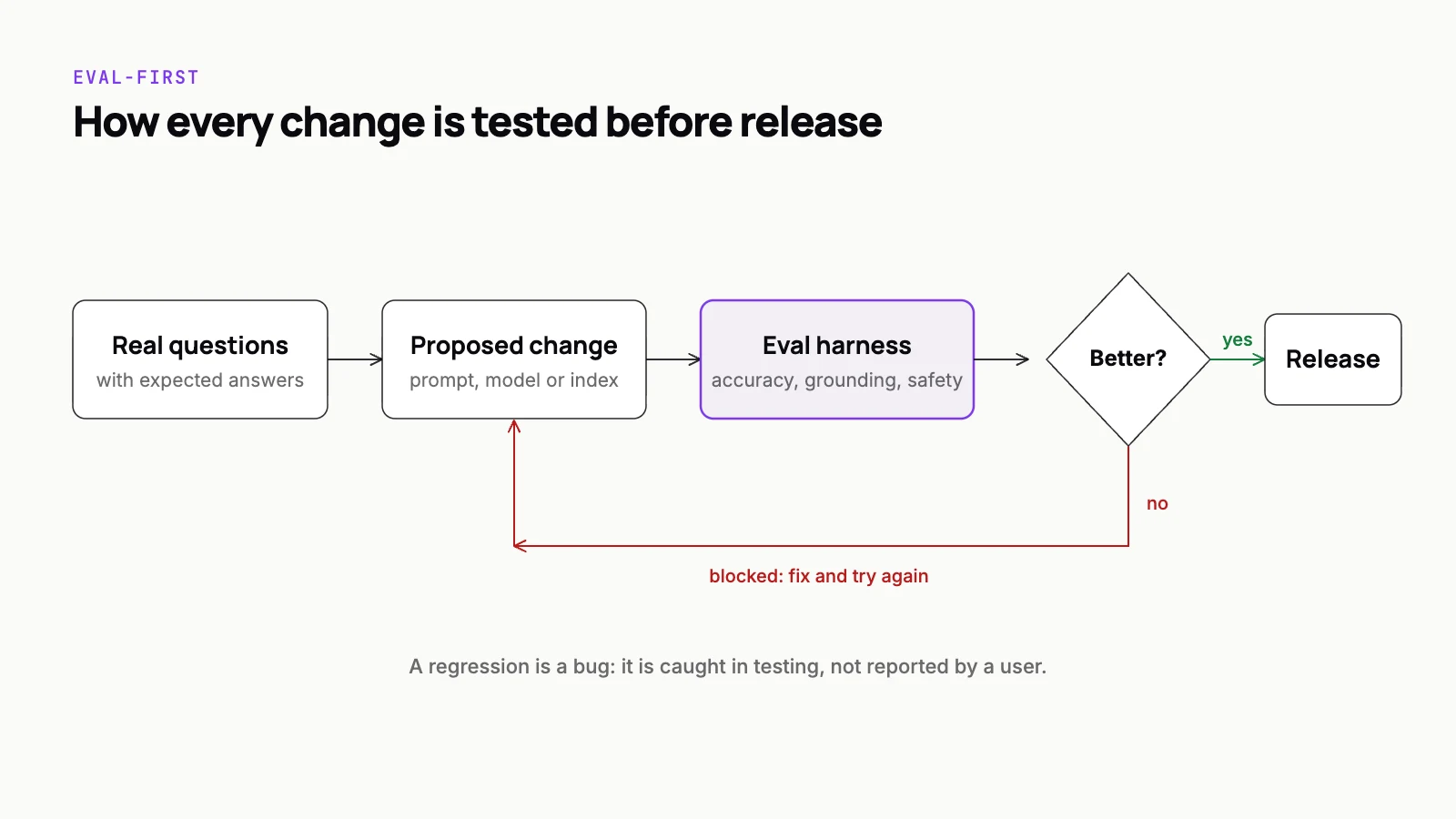
SI features in SaaS products usually fail after launch because nobody is measuring them, so quality slips quietly as prompts, models and user behaviour change. A demo is tested on a handful of friendly examples, while production brings messy inputs, edge cases and new model versions. The common gaps are predictable: no evaluation set built from real user tasks, prompts edited ad hoc instead of versioned and reviewed like code, context windows that overflow in long sessions, and inference cost that grows with adoption. The fix is to build the evaluation harness before the feature, run it on every deployment, and track quality, faithfulness, latency, cost and safety with regression alerts. Usage analytics then show whether the feature lifts activation and retention or sits unused. Octalcode applied this approach to Cyest SIMS AI, embedding copilots across an engineering-ops console with a custom eval harness that runs regression suites on every model change.
How do autonomous workflow agents work inside a SaaS product?

Autonomous workflow agents complete multi-step tasks for users by planning the steps, calling the product's own tools and APIs, and checking results before moving on. A user states a goal, such as researching a set of accounts and drafting follow-up notes, and the agent breaks it into actions like search, data lookup, drafting and record updates. Each action runs with that user's own permissions, so the agent can never see or change more than the person could. Confidence checks decide whether to proceed, ask a clarifying question or hand control back, and destructive actions need explicit approval. Every step is logged, which lets users review what happened and lets the product team debug failures. Agents are evaluated on a suite of realistic tasks scored for completion, correctness and cost, rerun on each change. The same structure powers SI-guided onboarding, where users describe the setup they want and the agent configures it inside the product.

Diagram of an eval-first release loop: real questions with expected answers and a proposed change to the prompt, model or index go through an eval harness for accuracy, grounding and safety; only a change that scores better is released, otherwise it is blocked and fixed.
Every change is tested against real questions before release.

02 · What makes SI SaaS hard

Four challenges we solve first.

  1. SI features that impress in demos fail in production

    Without evals, you don't know your feature is degrading. We build the eval harness before the feature, so you know it's working from day one.

  2. Prompts are product logic

    System prompts change behaviour. They need version control, testing, and review like any other product code, not ad hoc editing in a dashboard.

  3. Context window management

    Keeping conversations coherent without blowing the context window requires architectural decisions most teams make too late. We design for this upfront.

  4. LLM cost scales with success

    Popular SI features can generate unexpected API costs. We design cost controls, caching layers, and model routing from day one, not after the bill arrives.

Proof, not promises

Twenty-plus SI systems shipped to production. One playbook, six industries, and a team that stays past launch.

SI systems live in production
20+
Senior engineers & researchers
21+
Upwork rating, 3 verified reviews
5.0
Founded in Lahore
2022
Verified Upwork clientSI product engagement · 5-star review

03 · Common questions

Before you brief us.

How do you integrate an SI copilot into an existing SaaS product?
We expose the SI feature via a backend API layer that your frontend calls. The copilot gets context from your product's data model (user state, relevant records, and permissions) without requiring a UI rewrite.
What does "eval infrastructure" actually mean?
An eval harness is a test suite for your SI feature: a set of test cases with expected outputs, scored automatically on each deployment. It's the difference between knowing your feature works and hoping it works. We build this before writing the feature itself.
How do you control LLM costs as usage scales?
We implement prompt caching for repeated context, model routing (use a cheaper model when the task doesn't require a frontier model), response caching for deterministic queries, and token budget guardrails. Cost architecture is part of the design, not an afterthought.
Can you help us decide which SI features to build first?
Yes, we typically run a one-week SI feature audit before any build. We review your product, your user data, and your competitors, then recommend the highest-ROI SI features with effort estimates and expected retention impact.

Available for new engagements

Ship your SI feature with confidence.

30 minutes, one of our seniors, no slide deck. By the end of the call you will know whether we are the right team, and if not, who is.

Or call +1 (512) 710-5701

Let's scope it.Instant answers · free project scoping