Book a consult
Services

Production SI, engineered end to end, six eval-gated service lines.

Visit Services →
Solutions

The same playbook, tuned to the constraints of the sectors we ship into most.

Visit Solutions →
Live Projects

Proof, not promises, selected case studies and recognition.

Visit Live Projects →
How we work

A transparent, 3-phase playbook from first audit to embedded team.

Visit How we work →
Studio

The senior team behind the work, and how to reach us.

Visit Studio →
octalcode
Services
Solutions
Live Projects
How we work
Studio
● OCTALCODE · INFINITE SOLUTIONS · ONE AGENCYBook a consult ↗

LLM integration

LLM features in the software you already run.

We add LLM features to existing web apps, mobile apps and internal systems without a rewrite: one SI service beside your product, connected to your data with the right permissions, rolled out behind a feature flag, with a fallback when the model is slow or wrong.

01 · What we build

Integration audit

We start with your codebase and your data: how records are stored and permissioned, how auth works, where latency budgets are tight, and which feature has a clear user and an output someone can check. You get a written plan before any build starts.

02 · What we build

One SI service beside your app

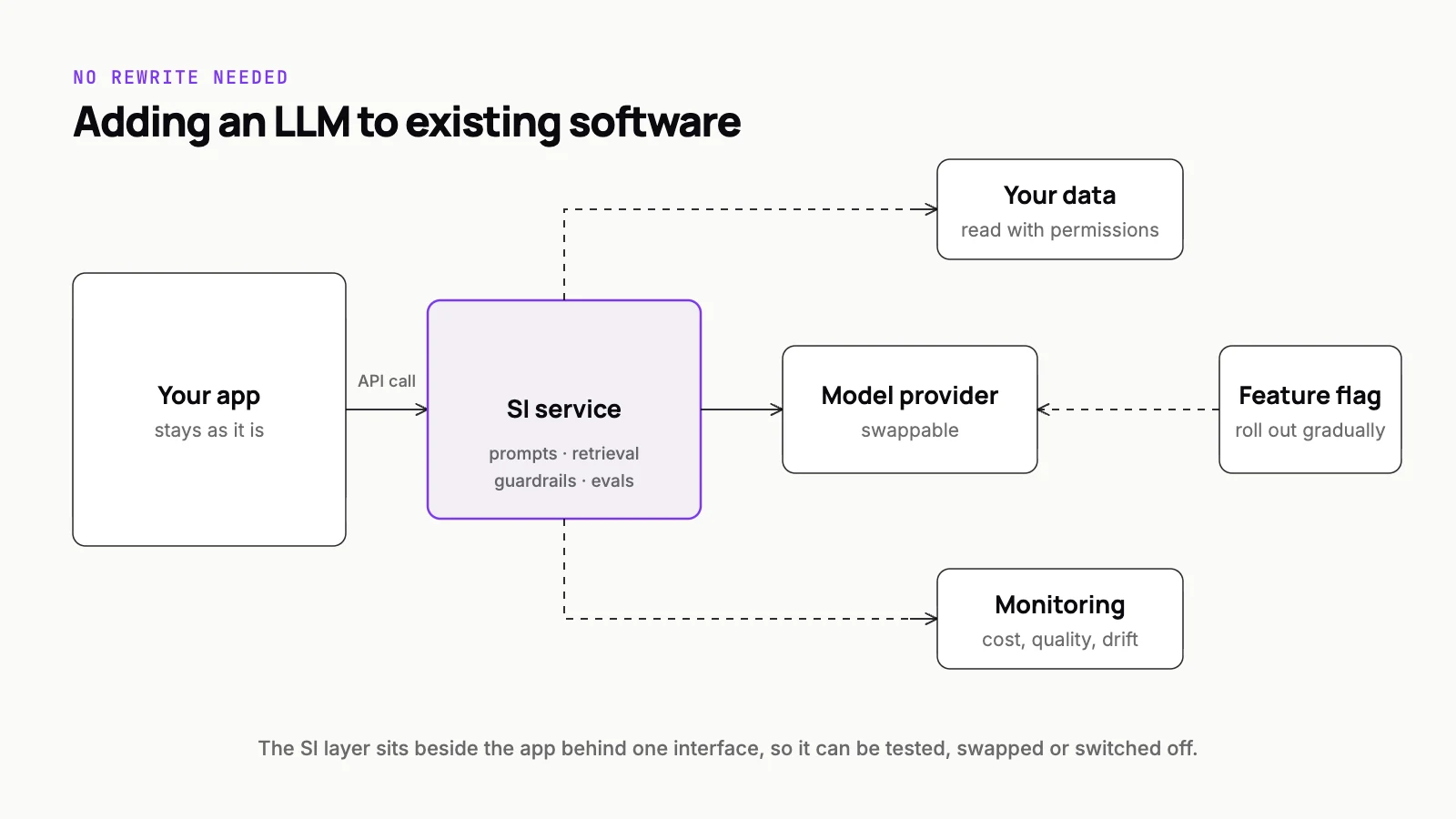
Prompts, retrieval, guardrails and model calls live in one service behind a stable interface instead of being scattered through your code. Your product calls one endpoint, and the model behind it can change without touching the rest of the app.

03 · What we build

Your data, with permissions

Features read from your own records and documents, with each user’s permissions applied before anything reaches a model. Where answers must come from documents, we build retrieval with citations.

04 · What we build

Model choice and version pinning

Hosted models from OpenAI, Anthropic and Google, or open models in your own cloud, chosen per feature on a test set built from your data. Versions are pinned, so a provider update never changes behaviour without a test run first.

05 · What we build

Rollout and operations

New features ship behind a feature flag to a small group first, with timeouts and a non-SI fallback so the core product keeps working. Every model call is logged with its cost, latency and a redacted prompt, and an eval set gates each release.

Straight answers

The short version.

What are LLM integration services?

LLM integration services add large language model features to software a business already runs, such as a web app, a mobile app or an internal system, without rebuilding it. The work usually starts with an audit of the codebase and data: how records are stored and permissioned, how authentication works, where latency budgets are tight, and which first feature has a clear user and an output someone can check. The integration itself is best built as one SI service beside the product, holding prompts, retrieval, guardrails and model calls behind a stable interface, so the app calls one endpoint and the model provider can change without touching core code. Data reaches the model only after each user’s permissions are applied. Models are chosen on a test set built from the client’s own data and pinned to a version. Features roll out behind a feature flag with timeouts and a fallback, and every call is logged for cost, latency and quality.
How do you choose an LLM for an existing product?

You choose an LLM for an existing product by testing candidates on your own data against the bar the feature has to clear, not by reading public benchmarks. Start by writing down what good output looks like for the feature, then build a test set from real inputs with answers a domain expert would accept. Run several hosted and open models against it and compare quality, latency and cost per request, because the smallest model that clears the bar is often the right one. Check each provider’s data terms: whether inputs are used for training, how long they are retained and where they are processed. If data cannot leave your environment, an open model in your own cloud may settle the question. Put the chosen model behind one interface in your code and pin its version, so a later switch, or a provider retiring the model, means a test run and a configuration change rather than a rewrite.

Diagram of adding an LLM to existing software without a rewrite: the existing app calls one new SI service that holds prompts, retrieval, guardrails and evals, reads your data with permissions, calls a swappable model provider, is monitored for cost, quality and drift, and is rolled out behind a feature flag.
The SI layer sits beside the app behind one interface.

02 · How we integrate

Beside your app, not inside it.

  1. No rewrite

    The SI layer sits beside your product. Your core code changes only where the new feature appears.

  2. One feature, measured

    The first feature has a clear user and an output that can be checked. What it shows decides the next one.

  3. Your data, your rules

    Permissions apply before data reaches a model, and personal data stays out of prompts and logs when the feature does not need it.

  4. Fail soft

    Timeouts, fallbacks and streamed responses mean a slow or wrong model never breaks the page it sits on.

03 · Where to start

Pick a feature you can check.

Good first features

  • Search across your own records
  • Summaries of long documents or threads
  • Drafts a person reviews before sending
  • Sorting and routing incoming requests

Harder first features

  • Fully automatic decisions on money or health
  • Outputs nobody can check
  • Features that need data you cannot share yet

What you keep

  • The SI service and its code
  • The test set and eval harness
  • A runbook and the monitoring
How to add an LLM to existing software

04 · Tech stack

Fits what you run.

Models

  • OpenAI
  • Anthropic Claude
  • Google Gemini
  • Open models served with vLLM

Your stack

  • React and Next.js
  • Node.js and Python services
  • Flutter and React Native
  • Your existing APIs

Data

  • Postgres with pgvector
  • Elasticsearch / OpenSearch
  • Your databases and document stores

Operations

  • Feature flags
  • Tracing (Langfuse, LangSmith)
  • Eval harnesses in CI

05 · Common questions

Before you brief us.

Do we need to rebuild our product to add LLM features?
No. We add one SI service beside your product and call it from the places where the new feature appears. Some data-model changes are common, and when the gaps run deep we plan a staged migration rather than patching around them.
Which LLM should we use?
The one that clears the bar on your own test set at a cost and latency you can live with. We are model-agnostic, compare candidates on your data, and keep the provider behind one interface so you can switch later.
What happens when the model is slow or unavailable?
The feature degrades, the product does not. Calls have timeouts, responses stream so users see progress, and each feature has a non-SI fallback or a second provider ready.
Will our data be used to train the provider’s models?
We choose providers and settings whose terms rule that out, get retention terms in writing, and keep personal data out of prompts when the feature does not need it. If your data cannot leave your environment, open models in your own cloud are an option.
Can you add LLM features to a mobile app?
Yes. We decide per task what runs on the device for speed and privacy and what runs on the server, and design the app for streaming output and graceful failure.

Available for new engagements

Add SI to what you already have.

30 minutes, one of our seniors, no slide deck. By the end of the call you will know whether we are the right team, and if not, who is.

Or call +1 (512) 710-5701

Let's scope it.Instant answers · free project scoping